
I have served as a Product Owner for startups like DigiFox, and have managed Agile projects like Omnipod’s Global File Standardization effort. While this page will focus on the high-level responsibilities of serving as a Project Manager / Product Owner, I will also make note of how the UX discipline fits into each phase.
High Level Methodology
Organization and Preparation
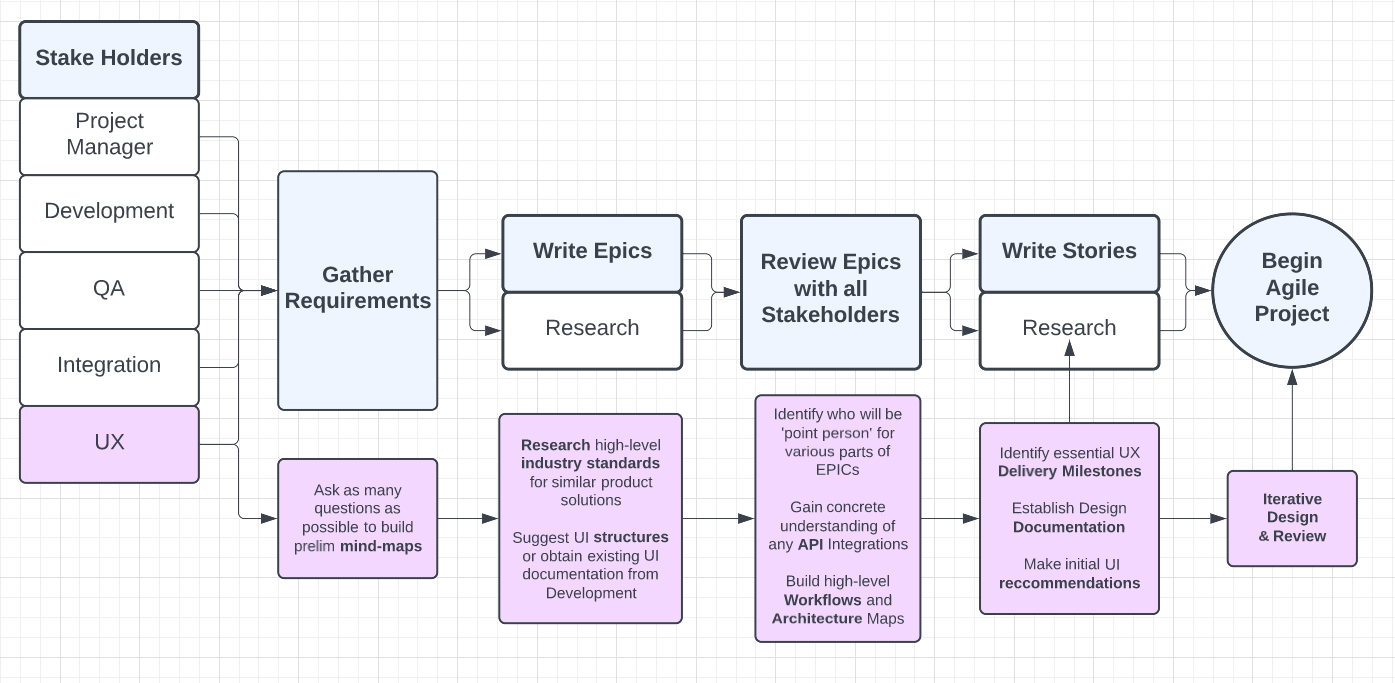
The diagram above illustrates a basic workflow for high-level planning. UX goals and efforts during each stage of planning are featured in Purple. I will presume that I am working within a mature Agile environment. Primary Stakeholders will be the Project Manager, UX, Lead Developer, QA Director, and the lead Integrations Specialist.
Gather Requirements
Stakeholders meet to collaboratively offer their expertise and ask important questions to other departments. Ideally, gaps in knowledge and understanding will be bridged during this process. UX will facilitate building preliminary Mind-Maps on a whiteboard or diagramming software.
Ideal: Gathering Requirements will also include User-Facing Stakeholders like Marketing, Client Support, etc… UX can collaborate with them to develop high-level User Profiles that represented prioritized demographics.
Write Epics and Research
As the Project Manager coordinates with involved Stakeholders to flesh out Epics, UX will begin to research any existing industry standards or established global design systems that apply to the project. It is expected that the Development team will have established what language the project will be built with. With that knowledge in hand, UX will partner with Dev to also select the most optimal UI Component Library for the project. As an example, UX might suggest KendoUI for a Javascript project that will employ many tables and grids.
Review Epics
Even at this stage of high-level planning, iterative review is essential. Stakeholders and Team Leads should reconvene to compare notes and ensure that everyone is on the same page. This is generally the stage where UX begins to partner with Integrations and QA to map out the project’s architecture and preliminary workflows, identifying what functionality is ‘in-house’ and what is dependent on API.
Story Breakdown and Design
UX will provide any advice or guidance that the PM requests. Ideally, the PM will tag UX in any stories that require Recommendations or Design. Once written, UX and PM will agree upon reasonable Delivery Milestones. UX will create a repository for any project-specific documentation that is not covered by the Component Library. Recommendations are generally text-only explanations of what standard components are needed to solve for a story, ideally with links to appropriate documentation. After UX Recommendations are added to eligible stories, UX will begin making Deliverables as needed: detailed workflows, wireframes, mockups, etc…

Begin Agile Project / Sprint Cadence
The diagram above illustrates various steps and team responsibilities in an iterative (Agile) development lifecycle. The cycle flows from start-to-finish and begins anew. All steps are relevant. It is a repeating pattern that seamlessly ‘tesselates’ at any level of complexity. High-Level quarterly growth, or Bi-Weekly Agile Sprints: the same cadence is replicated and renewed.
 HEADWRIGHT